Hey there! I’m a supplier of Steel Plate Induction Heating Production Lines, and I’m super excited to take you through the working principle of these amazing systems. You know, in the metal – processing industry, getting that perfect temperature for steel plates is a big deal, and that’s where our induction heating production lines come into play. Steel Plate Induction Heating Production Line
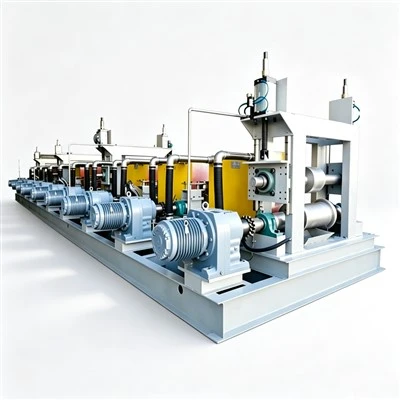
Let’s start with the basics of induction heating. It’s a pretty cool technology that uses the principles of electromagnetism. When you think about it, it’s all about how electric currents can create magnetic fields and, in turn, how these magnetic fields can induce currents in conductors. In our case, the conductor is the steel plate.
The heart of our Steel Plate Induction Heating Production Line is the induction coil. This coil is made of a special conducting material, usually copper, because it’s a great conductor of electricity. When an alternating current (AC) is passed through this coil, it creates an alternating magnetic field around it. This is the first step in the whole process.
Now, when we place a steel plate near this induction coil, something really interesting happens. The alternating magnetic field generated by the coil penetrates the steel plate. According to Faraday’s law of electromagnetic induction, this changing magnetic field induces an electric current, called an eddy current, inside the steel plate.
Eddy currents are the key to the heating process. These currents flow in closed loops within the steel plate. And as the currents flow, they encounter resistance from the material of the steel plate. You see, just like when you rub your hands together and they get warm because of friction, when these eddy currents flow through the steel, they face resistance, and this resistance causes the steel to heat up. It’s like a mini – electrical heater right inside the steel plate itself.
One of the great things about this process is that the heating is very efficient. Unlike some other heating methods where a lot of heat is lost to the surrounding environment, induction heating heats the steel plate directly. The energy is transferred straight to the plate, so there’s less waste.
Let’s dig a little deeper into how we control the heating process. We have a power supply unit that controls the frequency and intensity of the alternating current flowing through the induction coil. By adjusting the frequency, we can control how deep the eddy currents penetrate the steel plate.
For example, if we use a high – frequency current, the eddy currents will be concentrated near the surface of the steel plate. This is great for applications where we only need to heat the surface, like in some surface hardening processes. On the other hand, if we use a low – frequency current, the eddy currents will penetrate deeper into the plate, allowing us to heat the entire thickness of the plate evenly.
The intensity of the current also plays a crucial role. A higher current means more energy is being transferred to the steel plate, which results in faster heating. We can adjust the current based on the size and thickness of the steel plate, as well as the desired final temperature.
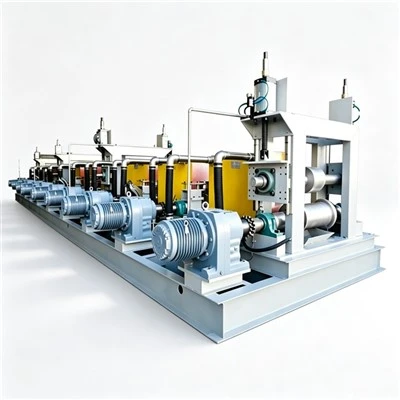
Now, let’s talk about the production line aspect. Our Steel Plate Induction Heating Production Line is a well – coordinated system. It usually starts with a loading area where the steel plates are placed onto a conveyor system. The conveyor moves the plates through the induction heating zone at a controlled speed.
This speed is important because it determines how long the steel plate is exposed to the induction heating. If the plate moves too fast, it won’t reach the desired temperature. If it moves too slow, it might get over – heated. So, we have sensors and control systems in place to monitor and adjust the speed of the conveyor.
After the heating zone, the steel plates move on to the next stage, which could be a forming or a quenching stage, depending on the application. For instance, if we’re using the heated steel plates for forging, they’ll go straight to the forging press. And if it’s for hardening, they’ll be quenched in a special liquid to rapidly cool them down and achieve the desired hardness.
We also have to take care of safety and maintenance in our production lines. The induction heating process generates a lot of heat, so we have proper insulation and cooling systems. The cooling systems are used to prevent the induction coil and other components from over – heating. We use water – cooling systems in most cases because water is a great coolant.
In terms of maintenance, we regularly check the induction coil for any signs of wear and tear. The electrical connections are also inspected to ensure there are no loose connections that could cause a loss of efficiency or even a safety hazard.
Another important feature of our production lines is the automation. We use advanced control systems that can be programmed to heat the steel plates to a specific temperature, at a specific speed, and for a specific duration. This not only improves the quality and consistency of the heating process but also reduces the need for manual labor.
Now, you might be wondering about the applications of our Steel Plate Induction Heating Production Lines. Well, they’re used in a wide variety of industries. In the automotive industry, they’re used for forging engine parts like crankshafts and connecting rods. The aerospace industry uses them for heating steel plates for aircraft components. And in the construction industry, they’re used for bending and shaping steel beams.
If you’re in the market for a reliable and efficient Steel Plate Induction Heating Production Line, then you’ve come to the right place. Our production lines are designed with the latest technology and are built to last. We offer customized solutions to meet your specific needs, whether you’re a small – scale manufacturer or a large industrial plant.
Reaching out to us is easy. Just drop us an email or give us a shout, and we’ll be more than happy to discuss your requirements and provide you with a detailed quote. Investing in our Steel Plate Induction Heating Production Line could be the smart move for your business, as it can improve your production efficiency, reduce energy consumption, and enhance the quality of your products.
Induction Quenching and Tempering Production Line References
- "Electromagnetic Induction and Its Applications" – A textbook on basic electromagnetism concepts.
- "Industrial Heating Technologies" – A comprehensive guide on different heating methods in the industry.
- "Automated Production Line Design" – A resource for understanding the design and operation of industrial production lines.
Hebei Yuantuo Electromechanical Equipment Manufacturing Co., Ltd.
As one of the most professional manufacturers and suppliers of steel plate induction heating production line in China, our products have good reputation in the market. Please rest assured to buy advanced equipment made in China here and get quotation from our factory. Customized orders are welcome.
Address: Yanshan Street West and Jialingjiang Road North, Economic and Technological Development Zone, Wuqiao County, Cangzhou City, Hebei Province, China
E-mail: yuantuotech01@gmail.com
WebSite: https://www.yuantuoem.com/
