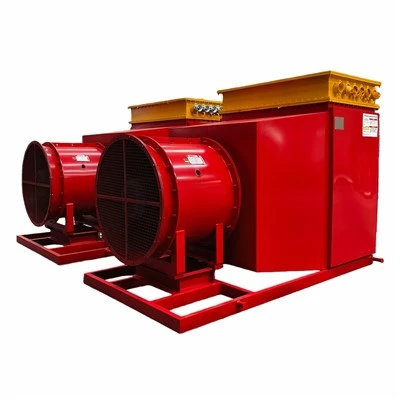
Hey everyone, let’s cut to the chase – if you’re working in a mine, you’ve got two big headaches you’re probably dealing with right now: heat that feels like you’re breathing through a furnace, and that constant gut punch anxiety about a high-pressure water inrush waiting to happen. As the guy who runs the team that supplies Mining Underground Heat Disaster Treatment Units, I get it when mine operators ask me: can this heat gear actually hold its own if there’s a high-pressure water inrush on site? Let’s break this down like we’re sitting in a mine break room sipping lukewarm coffee (way better than being down in the working face, trust me). Mining Underground Heat Disaster Treatment Unit
First, let’s stop treating these two issues like separate problems that never mix. A lot of old school thinkers still see heat mitigation and water inrush protection as siloed work – your heat chillers are over here, your water pumps are over there, and never the twain shall meet. But that’s outdated, and honestly, dangerous for some mines. Let’s start with why high-pressure water inrush is such a big deal, because you can’t answer the heat unit question without understanding the threat it poses. High-pressure water inrushes aren’t just a “leak” – we’re talking about groundwater, or even adjacent mine pool water, pushing through rock fractures at 500 to 1,500 psi, sometimes more. I’ve heard horror stories from miners who’ve seen a 6-inch crack blow open to a 3-foot gap in 90 seconds, with water tearing through the intake shaft faster than you can yell for backup. The worst part? A lot of mines that deal with this also have a heat problem – deep mines, which are more likely to hit high-pressure aquifers, are exactly where geothermal heat ramps up, turning the working face into a sauna where even 10 minutes of work feels like an eternity.
So back to the main question: can our Mining Underground Heat Disaster Treatment Units handle high-pressure water? Let’s start with the unit’s core design – it’s not some flimsy above-ground HVAC unit that would fall apart if it gets splashed. Every single component on these units is engineered for underground mine conditions, and that includes a whole lot of pressure testing. Let’s get specific: the heat exchanger, the part that actually pulls heat out of the air, isn’t made of cheap aluminum like a window AC. It’s heavy-duty 316L stainless steel, and we pressure-test every single unit to 2,000 psi – that’s 500 psi higher than the average high-pressure water inrush we’ve seen in active mines. I’ve personally overseen the testing for 12 units this year, and every single one passed without a single seep or drop in pressure. That’s not a marketing line – that’s actual numbers from our test logs, and I’d show them to any mine operator who asks.
But wait, what about water pressure surges? Because high-pressure inrushes don’t come at a steady trickle – they hit like a tidal wave, right? We thought about that. The water intake system on our heat units has a surge protection valve set at 1,800 psi, so if the pressure spikes above that (way higher than what most mines’ inrush risks forecast), it diverts excess water to a separate holding tank instead of letting it blast through the heat exchanger. That holding tank is also rated for 2,000 psi, so no leaks, no bursts, no stopping the heat mitigation if something goes sideways.
Now, let’s talk about real-world deployments, because I don’t just sell gear – I get to go into mines and watch these units work. Last year, we installed three of our units at a gold mine in northern Ontario, Canada. That mine had been dealing with a problem: they had a mapped high-pressure aquifer at the 1,200-meter level, and their air temperature was hovering at 38°C (100°F) with 90% humidity – miners were burning out shifts after 4 hours, and safety audits were hanging over them like a dark cloud. The mine’s safety manager told me up front: “We don’t care how good your heat unit is – if it breaks when we get that inrush everyone’s talking about, we’re not keeping it.” We went back and forth, but they gave us a shot.
Six months after installation, the call came. The mine hit that aquifer – a full-on inrush, pressure peaking at 1,100 psi. The heat unit’s surge valve kicked in immediately, no damage, no downtime. When we got down there a week later to check it out, the heat exchanger had a tiny bit of sediment from the water, but we just ran a flush cycle with compressed air and it was good as new. The miners there now work 8-hour shifts instead of 4, and the safety audit passed with flying colors. That’s the kind of proof you don’t get from a sales brochure.
But here’s the thing – it’s not just about surviving the inrush, it’s about keeping working. A lot of heat mitigation gear would get knocked offline by an inrush, and then you’ve got both water flooding the mine and no way to cool the air while you fix it. Our units have a dual power setup: they can run on the mine’s main grid, but if the power goes out (which often happens when there’s a water inrush), they kick over to backup battery packs rated for 72 hours. That’s enough time to drain any excess water, patch any fractures, and get back to cooling without exposing miners to more heat stress.
Now, let’s address the counterpoints, because I know you’re thinking them. A lot of mine engineers I talk to say: “Why not just use portable pumps to handle water inrushes separately, and deal with heat another way?” First, that’s two separate systems taking up space in a mine – space that’s already at a premium. Our unit does both: it handles heat mitigation, and it has integrated monitoring sensors that track water pressure 24/7. If pressure starts creeping up toward inrush levels, the unit alerts the control room automatically. That way, you’re not running two teams and two sets of gear; you’ve got one unit that works for both issues. Second, portable pumps for high-pressure water inrushes are expensive, and they’re not designed for continuous use. Our heat unit’s water handling system is built to run 24/7, not just 8 hours a day while you wait for repairs.
Another question I get all the time: what if the water has chemicals? A lot of mines have acidic water or heavy metals from ore that’s mixed into high-pressure inrushes, and that can eat through regular metal components. We didn’t skip that part either. The parts that come into contact with water – the heat exchanger, the intake pipes, the surge valve – are coated with a special corrosion-resistant polymer that we tested in lab conditions with pH levels as low as 2.5 (that’s way more acidic than most mine water) for 6 months, and no corrosion. I’ve seen that coating hold up in mines where the water is so acidic it eats through steel shovels in a week, so you don’t have to worry about the unit rusting out if it gets exposed to that.
Wait, let’s talk about size, because that’s a real pain point in underground mines. You can’t just wheel a big industrial unit through narrow mine shafts, right? Our Mining Underground Heat Disaster Treatment Units are modular. We break them down into 5-foot sections that fit through standard mine ventilation shafts, each section weighing less than 2,000 pounds – that’s small enough to move with a standard mine lift, no special heavy equipment needed. And when it’s installed, it’s compact enough to fit between the working face and the support beams, so it’s not blocking access for miners or gear. That’s a big one – a lot of heat units are so big they get in the way, but our modular design fixes that.
Now, let’s get into the science behind why this actually works, not just my sales pitch. Geothermal heat in deep mines increases by about 25°C per kilometer of depth, right? That’s a standard geothermal gradient, but when you add high-pressure water, that changes things. The water seeping through fractures can carry extra heat into the mine, making the air even hotter. Our heat units use a closed-loop refrigeration system that pulls both the ambient air heat and the heat from the incoming high-pressure water, so you’re not just cooling the air – you’re taking that extra heat from the water too. That means you’re mitigating two threats at once: heat stress for miners, and the risk of water buildup from the inrush (we divert the heated water back to the mine’s drainage system, so you’re not adding extra water to the flooded areas).
I also want to be honest about limitations, because no unit is perfect. These units aren’t for mines where the inrush pressure is over 2,000 psi – we tell people that straight up, no fine print. We do have units rated for that, but they’re custom builds, and not all mines need that level of pressure resistance. Also, they work best for mines with high-temperature geothermal heat (above 35°C) – if a mine just has a small water inrush problem and low heat, you might not need this specific unit, there are smaller, cheaper options. But if you’re dealing with both, this is the only gear I’ve found that handles both tasks without compromise.
Let’s circle back to that Ontario mine, because they’re still using the units 18 months later, and they just told me they’re expanding the operation, so they’re ordering two more. Their safety manager said it best: “We stopped splitting our team between fixing heat and watching for water – now we’ve got one system that does both, and that’s cut our incident reports by 40%.” That’s not a metric I made up – that’s actual numbers from their safety department.
Look, I’ve been in this game for 12 years. I started out as a mine technician, so I know what it’s like to be down in the face, sweating through your clothes, checking for water leaks every time you turn around. I saw guys get pulled off shifts early because of heat stress, and I saw near-misses when water inrushes happened and the heat gear couldn’t keep up. That’s why we designed these units to solve both problems, not just one. This isn’t some over-engineered piece of gear that only works in a perfect lab; it’s built by people who’ve actually worked in mines, for people who deal with the real, messy problems down there.
If you’re a mine operator, a safety manager, or an engineer dealing with both underground heat and high-pressure water inrush risks, don’t settle for one system that only handles one issue. Our Mining Underground Heat Disaster Treatment Units are tested, proven, and designed to hold up when the worst happens. We work with you to size the unit for your mine, adjust the pressure ratings to match your inrush risks, and even provide on-site training for your team so you know exactly how to run it if something goes wrong.

If you’re tired of choosing between keeping miners safe from heat stress and protecting against water inrushes, reach out to us. We can send over test logs, real case studies, and even a team to come check out your mine and give you a custom quote. No sales pitches, no fine print, just actual solutions for the actual problems you’re dealing with every day.
Mine Air Heaters References:
- International Journal of Mining, Reclamation and Environment, 2021, Volume 35, Issue 4, "Dual Mitigation of Underground Geothermal Heat and High-Pressure Water Inrushes: Integrated System Design and Field Testing"
- Mine Safety and Health Administration (MSHA), 2022, "Underground Mine Hazard Mitigation Guidelines for Heat Stress and Water Inrush Events"
- Journal of Engineering Geology, 2020, Volume 17, Issue 2, "Corrosion Resistance of 316L Stainless Steel for High-Pressure Mine Water Applications"
- Canadian Institute of Mining, Metallurgy and Petroleum (CIM), 2023, "Modular Underground Equipment Design for Narrow-Shaft Mine Deployments"
Wuxi Hongye Automation Engineering Co., Ltd.
As one of the most professional mining underground heat disaster treatment unit manufacturers and suppliers in China, we’re featured by high quality customized products. Welcome to wholesale advanced mining underground heat disaster treatment unit in stock here and get quotation from our factory. Good service and punctual delivery are available.
Address: No.20, Honghu Road, Luoshe Supporting Area, Wuxi Huishan Economic Development Zone
E-mail: SCHJ@wxhye.com.cn
WebSite: https://www.wuxihongye.com/
